|
EGOVOS invites Microsoft and we respond
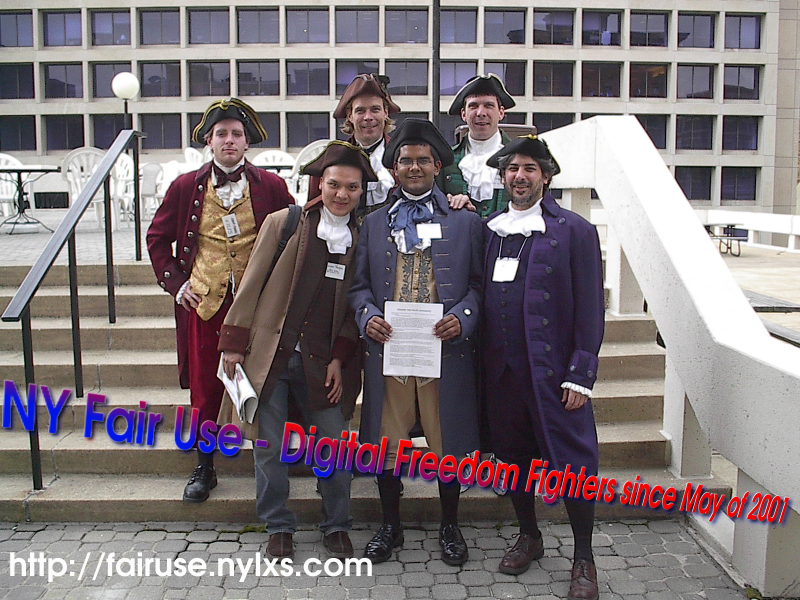
Action at the department of Commerce
Who Owns the Music in Open Office Format
Who Owns the Music in Post Script Format
Petition Open Office Format
Text of Trusted Computing is Theft
Who
Owns That Downloaded File Anyway?
US
CONSTITUTION:
Amendment
IV
The
right of the people to be secure in their persons, houses, papers,
and effects, against unreasonable searches and seizures, shall not
be violated, and no warrants shall issue, but upon probable cause,
supported by oath or affirmation, and particularly describing the
place to be searched, and the persons or things to be seized.
Amendment
V
No person shall be held to answer for a capital, or otherwise
infamous crime, unless on a presentment or indictment of a grand
jury, except in cases arising in the land or naval forces, or in the
militia, when in actual service in time of war or public danger; nor
shall any person be subject for the same offense to be twice put in
jeopardy of life or limb; nor shall be compelled in any criminal
case to be a witness against himself, nor
be deprived of life, liberty, or property, without due process of
law; nor shall private property be taken for public
use, without just compensation.
Article
1:
The
Congress shall have power to ... promote the progress of science and
useful arts, by securing for limited times to authors and inventors
the exclusive right to their respective writings and discoveries;
We are the
Stakeholders
It's
more than a slogan. It's a fact, and one which the public demands
Congress to recognize. There it is. The rights
of every individual citizen, clearly stated in the US Constitution in
English as plain to understand today as it was when it was written
over 200 years ago. Individuals are guaranteed to right to be secure
in their persons, houses, papers and effects. This is absolute and
the foundation of Freedom. We can not have a free people if we are
subject to inspection, wiretapping, bullying and preemptive control
of our digital communication. We can not tolerate this any more than
we can tolerate wiretapping of our phone lines, spying on our private
letters, or burning of our books. It doesn't matter if the public
chooses to share music files or movies on a massive scale, individual
to individual. All that matters is that we are protected from
corporations and the government from doing so.
This
summer the Music, Software and Movie Industry has pressed both the
executive branch and the legislative branches of our government to
allow spying, preemptive filtering, and commandeering of personal
property in order to prevent the common distribution of information
which is protected by copyright. Anyone who reads the plain meaning
of the constitution can clearly see that these copyrighted articles
are owned by the public. Congress is only authorized to give limited
rights to creators of works in order to promote the publication
of more on them. And then, only if they are useful. We
fully demand protection from those who scam the public, and steal
from us our cultural heritiage.
Who
owns copyrighted works? It is the public. Tomorrow Congress can end
all copyright protections, and then there is none. But Congress can
never pass a law which ends our ownership of our papers, books and
property. We demand the same protection to share information on our
hard drives, on CD's, Vinyl, Tape and paper that is afforded used
books.
On
September 26th, 2002, in the House Sub-Committee on
Intellectual Property, while reviewing HR 5211, Congressman Berman
publically announced that nobody is talking about preventing the
sharing of a few files between individuals. Evidently, Congressman
Howard Berman seems to be misinformed. The Recording Industry
Association of America clearly says that they disagree. Their
statements on
http://www.soundbyting.com/html/copyright_101/music_copyright.html
clearly states:
“So the only LEGAL way to
reproduce a piece of recorded music -- uploading, downloading,
copying from a CD, whatever - is to get permission from the owners of
these different copyrights. It's called, obtaining a license”
This is just wrong.
Our homes are not businesses open to in discriminant industrial
policies. Our homes are private. We do not license our music and
our computers. We purchases them for cash. And we will use them as
we choose to, and we will share information with others without prior
constraint, and of our own free will. We are not pirates. We are
voters, and WE ARE THE STAKEHOLDERS.
In our private
lives, we will share what we choose to, we will educate as we see
fit, and we will build libraries for public access and to help
educate and provide for our children and the poor. And we will not
have the public treated as robbers and criminals.
If
the RIAA sees a legitimate copyright violation, we are protected from
their gross exaggeration of their legal rights by the fourth and
fifth amendments in the Bill of Rights. If the legalities of
prosecuting individuals under the law is not convenient for the RIAA,
we do not authorize a digital police state instead. We will not walk
down the path of George Orwell's 1984, where computers are used to
control the the thoughts and activities of the population. We will
not allow our property to be continued to be described as the
property of a Copyright Holders.
Finally, the public
is tired of the foot dragging by the Movie and Recording industry in
publishing materials electronically. We demand Congress force the
Copyright Holders to provide their end of their bargain in Copyright.
Congress should move immediately to force the media companies to
publish music on-line. Use forced licensing if you must, but get our
cultural heritage on the internet. The Music industry, especially,
has impeded innovation and job creation because of it's refusal to
publish. Nobody has the 'right' not to publish, once they have been
given a copyright and made works available. The NY Times reporter,
Amy Harmon, wrote on September 23rd:
(http://www.nytimes.com/2002/09/23/technology/23MUSI.html?pagewanted=print&position=top)
Concerns over piracy, money or unrelated
contract disputes have prompted artists like Madonna and Radiohead to
insist that their music not be distributed digitally. And even if the
artist and the label are on board, the publisher who represents the
writer of a song may not be. Sometimes it takes months to figure out
who the publisher is, since there are more than 30,000 of them in the
United States and their names are often not included on the CD.
"It's as if Franz
Kafka designed this system and employed Rube Goldberg as his
architect," said Rob Glaser, the chairman of MusicNet, which is
part-owned by his company, RealNetworks, along with AOL Time Warner,
Bertelsmann and the EMI Group. "It's full of tripwires."
The most glaring omissions
from the services are the entire catalogs of major labels that have
so far declined to license to the services backed by their offline
competitors. The Warner Music Group, the music division of AOL, and
the BMG unit of Bertelsmann have yet to license their music to
Pressplay. Likewise, Pressplay's owners, the Universal Music Group of
Vivendi Universal and Sony Music Entertainment, have not licensed
their recordings to MusicNet. The EMI Group, the smallest of the five
major labels, has licensed to both MusicNet and Pressplay. And
Listen.com, which has no record labels among its corporate parents,
has licenses from all five major labels.
It is time for
Congress to step in and make the copyright holders publish on the
internet. We don't care is Madonna makes money or not. We care
that works are made available to the public. We give publishers
narrow, but well defined exclusive rights to profit from by
distributing copies of copyrighted work. We give these rights in
exchange for making them public. Their 'rights' are not the
inalienable rights, such as those defined in the Bill of Rights, but
subject to the will of the People. The People demand that they
publish, or otherwise strip them of their copyrights all together.
Response to Alex Paynes Slashdot Report about the DOC DRM Panel
We are rather dismayed at the posting of this biased and
incorrect review of the events of the DOC's panel. The document has
several mistakes which the author, Alex Payne, most have known prior to
presenting it to slashdot. Some of the mistakes just show a complete
fundamental lack of knowledge of the political process, which can best be
atributed to his young age and lack of experience in public politics.
First of all, we would like to thank the Department of Commerce for their
wonderful patients in handling the discourse in the room. It could have
very easily been the case that they could have closed out the public
entirely from watching this important issue discussed, and in fact, they
almost did that until NYLXS and NY Fairuse kindly pointed out that as a
matter of law, they could not prevent the public from attending a public
meeting of this type. And despite that, they could have been malicious
and thrown everyone out who clapped and participated in the hearings from
the crowd. Instead, the DOC was gracious enough to permit participatory
Democracy to function in the public, and it did function at the meeting
took place without being disrupted by NY Fairuse or anyone else.
Everything which happened at the meeting happened within the sandbox of
health, normal political discourse. Fortunately, Mr Bond, the chair of
panel understands what healthy political discourse is about, and is a fine
representative of America's open Democratic society, which in my opinion,
is the best government on earth. Many people and nations can learn well
from Mr Bond's tolerance and handling of this meeting, including many
people who follow slashdot and complain constantly about how the
government is brought off, but never lift a finger to actually participate
and work through the political process.
In Alex Payne's article on Slashdot and other venues, he wrongfully
reports that NY Fairuse never tried to join the panel through proper
channels. We have no idea how young Alex could have drawn this conclusion,
but clearly he never entered the NY Fairuse mail archives, which are
normally published on the NY Fairuse web site. Had Young Alex done his
job properly as a reporter of this event, he would have known that for the last
several weeks, we had many people in Washington and New York working on
getting into the panel. This included phone calls to Chris Israel, the
point man for the panel, and multiple phone calls to
Congressman, Anthony Weiner of Brooklyn, asking for help getting on the panel.
We were
simply snubbed from the process, and so we were relegated to listening to
the hearing from the gallery.
Before leaving NYC, we had a very serious discussion about our tactics for
political action in Washington. We considered holding a large and noisy
protest outside the Department of Commerce building, and bringing Steaks
to show that we are the stake holders in the DRM debate. It was the
decision of NYLXS and NY Fairuse to not take this tactic except as a last
resort. We felt that as members of a concerned public, that we needed to
make our presence felt within the audience of the hearing. We also felt
that under no circumstances would either organization take any action
which would interfere with the normal function of the panel, and in fact,
we succeeded on both counts.
Everyone on the panel was heard, and the panel debated all of the issues
present on the panels agenda. NY Fairuse did nothing to prevent any
member from being heard, nor did we interfere in anyway with the panel
members ability express their opinions in the discussion. Mr Bond and Mr
Rogan are skilled parliamentarians. NY Fairuse had strict discipline
in order to achieve the balanced goals of partipatory Democracy. And when
the transcript is released, or the recording of the meeting is made
available, it will completely demonstrate that as fact.
This is not to say that NY Fairuse quietly or timidly sat in the audience
without participating as audience members. First, Brett Wynkoop was
accidently recognized by the chair, and Brett graciously added much depth
and interesting debate to the conversation. Brett was simply sitting in
the only chair available to him near the table and raised his hand. His
comments about Magic Markers and CD Digital Rights Management Attempts was
picked up numerous times by the panel in discussing the problems of Fair
Use and the DMCA. One participant even gave us a legal opinion on the
matter of the CD DRM issue, which while we believe is incorrect within the
facts of the quoted court case and case law, still showed that the issue
of Fair Use is still important to some members of the panel.
Alex Payne, in his article says, "Geeks should be happy to know that their
voice is being heard by the tech industry". This seems to be a
misrepresentation of the statements given by the panel. Or perhaps Alex
himself doesn't understand the issues being debated. This wouldn't
surprise us since Alex got so many of the details wrong about the events
of the meeting itself. He seems to suffer from not completely
understanding events around him as they happen, and by a fundamental lack
of research prior to making reports. At no time did any of the tech
industry say a single word about protecting the publics basic property
rights under the 4th Ammendment of the US Constitution, which is the main
legal protection the public currently has to guarantee basic political
freedom. Instead, everyone on the panel, even Philips who best seemed to
grasp the idea that DRM is a snake pit of problems for the growth of
technology, gave lip service for the need to have DRM to protect and
enforce unfair Copyright Licensing Restrictions on the Public, which
otherwise do not exist from this simple cash sale of media and digital
devices.
Everyone on the panel was willing to grant some form of force contractual
arraignment on the public without a signed fairly negotiated agreement.
This violates the public privacy and property rights in their homes. Mr
Valenti kindly said that the Internet is delivery system. This
interpretation of the Internet is not only incorrect, but it is dangerous
to the political freedoms of the American People. The American Public,
and in fact all the peoples of the World, fill many roles in their lives
are human beings. One of which is our role as a consumer. But we also
play the role of producers, writers, artists, creators, publishers, and
most importantly, we play the role of FREE CITIZENS. The Internet was
never designed, nor can it be properly viewed as a delivery system. It
was designed from it's very beginnings as a form of communication device
like the telephone, and it is most accurately described today as a Press.
The Internet and Digital Computers are the Printing Presses of the 21st
Century and beyond. Individuals MUST be able have completely unfettered
Printing Press ownership without any interference from the government, or
for that matter, private industry, even with regards to the owners of
Limited Copyright Monopolies.
DRM, in all it's proposals can not overcome the requirements of a Free
Society because it prevents private ownership of our Printing Press (the
digital computer) and the copies of information on media such as DVD's,
Music CD's and Literature or Books. In order to do proper DRM, every
aspect of Computer I/O (In and Out), has to be monitored and controlled.
It immediately ends any notion of Fair Use and the two simply can not
co-exist. The elimination of the publics right to ownership, and fair use
of limited copyright monopolies can not be justified by any business plan,
or Copyright Ownership issues. If we have to make a choice between
unacceptable levels of Piracy, which in of itself is a term badly maligned
and manipulated by our Friends in the Copyright Monopoly Industry, and our
ability to protect private ownership and control of our communication
infrastructure and free press, then we have no choice, we must protect the
publics fundamental rights to property, ownership and free speech. Copyright
holders, and we have many members who are copyright holders, have existing
laws to protect their legitimate interests. The large media companies do not
have a right to ask the government to take away the Printing Press from the
common man just because they fear he will use the tools at his disposal
to make his views, art, creations available to the public. Make no mistake
this is battle for control of information publishing ability!
It's unfortunate that the panel actively suppressed NY
Fairuse from joining the panel. Had we been on the panel
they would have to have heard that legal expert Supreme Court
Justice
Sandra Day O'Conner has stated on legal record that she can no longer
make the determination of who a publisher, because with the
Internet, we are ALL publishers. And indeed we are. Even someone like
Alex Payne is capable of publishing the most ill conceived and
un-researched bias press reports on Slashdot under the current model of
the Internet. What greater proof do we need that the Stake holders to the
DRM issue are not being adequately heard, and that DRM is theft from the
public.
We got some press coverage. Check it out!
http://www.theregister.co.uk/content/6/26275.html
http://newsforge.com/newsforge/02/07/18/1644212.shtml?tid=19
http://news.com.com/2100-1023-944668.html
http://newsforge.com/newsforge/02/07/18/0155208.shtml
Some pictures of the event are here.
http://www.dslreports.com/shownews/19962
Your right to own and operate a computer is under attack!
Immediate action is needed!
Major action is now planned. Strategy meetings for January to be announced.
Location at the Killarny Rose, 82 Beaver Street, Beaver and Wall Street, Downtown NYC.
This is the Save the Libraries Campaign
NY Fairuse is trying now to meet with Congressman Weiner in
Washington DC. I encourage everyone to press for this face
to face with his staff in Washington. See the mailing list
archive for the current request to schedule a meeting.
we live
under is prohibited to be copied or distributed according to these legal
geniuses
Don't say "We the People" in Public....
Who We Are
New Yorkers for Fair Use is a group of New Yorkers
who have come together in the media capital of the world, in order to
protect a balanced Copyright in the digital age from people who would destroy
our ability to legally obtain or create digital copies of media
and use it. We see a new digital age where the easy copying of
music, video and print threatens the foundation of Copyright.
We must take action now!! This organization is formed to bring
to the front legislation which protects Copyright law and to encourage politicians
to produce balanced Copyright legislation. If we don't do something now, Copyright
will become irrelavent in the digital age. In order to protect Copyrighted works
we must assure Fair Use. Otherwise Copyright will be ignored
and piracy will destroy the foundations of the media industry!
What is Copyright?
Copyright is like love - everyone thinks they know what it is, but few actually understand what
it really means.
Historically, Copyright did not exist in western civilization. At the time of Shakespeare,
there was no Copyright.
At that time playwrights, poets, and artists would vigorously hide their works until playtime
for fear of piracy.
All poets and playwrights borrowed from each other. Shakespeare' Macbeth is a largely a copied
work of
previous versions. It is altered by Shakespeare. He added original verse and molded the play
that has
come down to us. Original elements are intertwined into previous versions from other
works. This was not only commonly done by playwrights, but accepted practice.
Prior to the Guttenburg Bible and the mass usage of the printing press, the reproduction of
cultural artifacts such as
literature and books of learning, was largely controlled by religious institutions like the
Catholic Church. The decreasing cost
of education and the obtaining of information challenged the political control of the Church,
and caused a social revolution. The Protestant revolution was the most visible, but not the
only result of the decreasing cost of information.
With increasing literacy and access to information, the middle class began to swell from the
ranks of peasantry.
They brought with them practical demands for works of art and learning, and the need to
produce original works of arts and sciences for business and spiritual reasons. People
started to demand control over the original creations they produced.
Copyright in Europe and Colonial
America
The first Copyright laws developed in Europe in response to the
increasing needs of this middle class.
By the 1600s in England, it was apparent that it was a benefit to the British nationstate
to have some control over the distribution of
certain works. Absolute control of original materials was given to Copyright holders.
Copyright was established in the law,
along with trade secret and patent laws, all designed to assure English dominance in the
industrial revolution which was slowly
taking hold. Copyrights were issued by the government on a case to case basis. Copyright
law and patents became an arm
of British colonial policy. Works on industrial processing and other areas were prevented
from being transported
out of the native isles of English Crown. This helped assure the colonial relationship of
England to her colonies,
and helped assure British sea power as well.
After the American Revolution, our Founding Fathers looked closely at the issue of Copyright
and patents. They determined
that an unlimited Copyright was inherently contrary to their aims to create a democratic
society. They recognized the need for
free association and free speech, which Copyright inherently limits. They recognized the
intrusion that Copyright presented
on individuals property rights. And most importantly, they realized that unlimited Copyright
would erode the principles of a shared
cultural heritage which we enjoy as a free people in a common civilization. Unlimited
Copyright would surely undermine a free
society.
American Copyright
American Copyright is based on the constitutional precept of a limited Copyright license
designed to promote the public well being.
All Copyright law is an extension of Congressional power to limit property rights and freedom
of speech of the public through a
limited Copyright license. This power is granted from the following paragraph in the
Constitution,
without which Copyright would be unconstitutional:
| [Congress can pass Laws]
To promote the progress of science and useful arts, by securing for
limited times to authors and inventors the exclusive right to their
respective writings and discoveries; |
Key to Copyright was the concept that Copyright is limited. This was a break in American law
from European
and English common law. Congress has the power to grant Copyrights, or to not grant
Copyrights.
Congress can revoke all Copyright protections tomorrow, and Copyright owners are without
resource.
This is different than Freedom of Speech, which is guaranteed in the 1st Amendment. Congress
can never suspend Freedom
of Speech or Freedom of the Press with the passage of a bill. The institution of Copyright as
defined by the Constitution meant
that by constitutional law, and as uphelded repeatedly in the Supreme Court, Copyright does not
supercede the constitutional
guarantees of the citizenry. Their property and freedom of speech are protected under the law.
The balance between the
exclusive rights of authors and inventors who have obtained Copyright, and the public's
inalienable rights is called Fair Use.
Fair use is the constitutional rights of citizens in respect to their legally obtained
property, which happens to be of copies
of works granted Copyright. Copyright is a privilege that is superceded by Fair Use
constitutional guarantees. Copyright
can never supercede Fair Use. Without Fair Use, Copyright makes a criminal of citizens using
Copyrighted works in support of a
free society and a free government.
This is further codified into statutary law under the Copyright Act:
|
Sec. 107. Limitations on exclusive rights: Fair use
Notwithstanding the provisions of sections 106 and 106A,
the fair use of a copyrighted work,
including such use by reproduction
in copies or phonorecords or by any other means specified
by that section, for purposes such as criticism, comment, news
reporting, teaching (including multiple copies for classroom use),
scholarship, or research, is not an infringement of copyright.
In determining whether the use made of a work in any
particular case is a fair use the factors to be considered
shall include -
-
(1) the purpose and character of the use, including whether
such use is of a commercial nature or is for nonprofit
educational purposes;
(2) the nature of the copyrighted work;
(3) the amount and substantiality of the portion used in
relation to the copyrighted work as a whole; and
(4) the effect of the use upon the potential market for or
value of the copyrighted work. The fact that a work is
unpublished shall not itself bar a finding of fair use if such
finding is made upon consideration of
all the above factors.
|
Recent Copyright
Issues
Recent trends in the law in response to the internet and the advent of digital medium have
assaulted Copyright.
Among the recent laws passed which threaten Copyright is the Digital Millennium Act which
Congress passed
in 1998 in response to pressure from the broadcast and mass media industry in the US.
Another law recently passed which attempts to destroy Copyright is the Sony Bono Copyright
Extension Act.
Since Copyright can not be legal without Fair Use, both of these laws, among others making
rounds on the Federal and State level,
are undermining the legal and moral foundation of Copyright. New Yorkers for Fair Use is an
organization which is determined
to protect the validity of Copyright law by protecting Fair Use and dispelling misinformation
on Copyright.
We would like you to know, first and foremost what is a legal use of Copyrighted material and
what is not.
First of all: Can I own an idea,
song, work of art, writing or other creative work of abstract human intellect?
No - One can not own an idea, even if you created it. You can only own a limited license
called a
Copyright or patent to exploit your idea for comercial purposes, or not to exploit it if you
choose to.
Intellectual Property is a misuse of language often used to confuse people about their rights
and responsibilities. It is similar to "The Democratic Republic of China" By supporting
responsible
Copyright legislation, you can best protect your rights under Copyright.
- Copying a Copyrighted work.
- Making an archive of Copyrighted works.
- Editing a Copyrighted work.
- Distributing a quote from a Copyrighted work within an original work for the purposes of
discussing that work.
- Giving a copy of a Copyrighted work to a friend without a charge or other monetary
consideration.
- Using the Copyrighted work without permission of the Copyright holder in a way the
Copyright holder did not initially approve of in its sale of the work to you.
- Destroying your copy of the Copyrighted work.
- Travelling with the Copyrighted work into a different jurisdiction.
- Selling your copy of the Copyrighted work.
- Making a copy of a Copyrighted work and selling it.
- Charging for the viewing a Copyrighted work without permission of the Copyright holder.
- Amassing a database of Copyrighted works and charging for access to that database.
- Mixing together Copyrighted works and selling your services for reading or playing that mix.
- FBI Warning on Video Tapes.
- The FBI Warning about copying a video tape is a lie. Owners of Copyrighted
material are allowed to copy the VHS Tape for their personal use. Copying is not a crime.
- Ripping CD's to MP3 files.
- This is LEGAL. Copying legally purchased Copyrighted material is a protected act
under the Constitution.
- Making copies of a Copyrighted article for a class discussion and distributing them to the
class.
- Legal and explicit under Section 107 quoted above.
- Sharing an MP3 music file, or a cassette tape of music without charge.
- This is LEGAL unless your doing this as part of a business plan or promotion. You can have
a website full of MP3's as long as it is not a business site, you are not selling ad space etc. If you can afford it, have fun.
- Copying software in a business.
- Illegal - Don't do it.
- Copying software you own for personal use.
- Legal if no money is passing hands.
- Sell copies of software you own and no longer use.
- Legal as a second sale.
|